AI adoption is no longer the maturity milestone for IT service management. The harder work is turning AI activity into measurable business outcomes.
The adoption-to-value gap extends well beyond the service desk. McKinsey found that nearly nine in 10 organizations now use AI in at least one business function, but nearly two-thirds have not begun scaling it across the enterprise. Thirty-nine percent of respondents attribute some enterprise-level EBIT impact to AI; most report that the impact is below 5%. Adoption alone does not create value; teams still need workflows, governance, and measures that connect AI activity to business results.
SolarWinds surveyed 844 IT professionals for the 2026 State of ITSM Report: From AI Potential to Real Payoff to understand where AI is helping, where it is adding work, and what separates productive adoption from expensive experimentation. The findings point to a more practical stage of ITSM maturity. Teams are putting AI to work in service desk workflows, but the benefits are uneven and often come with a maintenance burden that organizations didn’t plan for.
The last three State of ITSM reports trace how that challenge has taken shape inside the service desk. In 2024’s report, the conversation centered on the service management practices that help teams resolve work faster: automation, self-service, knowledge management, and SLA management. In 2025’s report, generative AI entered those workflows, with data showing its potential to improve incident resolution efficiency.
Now, AI is part of the workday for many survey respondents. The question is less about whether to use it and more about what it takes to use it well. Who maintains the tools? How much review does AI-generated output require? Does time saved on a ticket reduce workload, or does it simply make room for more work? And are teams measuring activity, or measuring results that matter to the business?
The 2026 survey looks at what separates AI that creates more work to manage from AI that helps the IT technicians deliver better outcomes.
The AI Creates Work Beyond the Ticket
The 2024 State of ITSM Report focused on the fundamentals that help IT professionals resolve work faster. Organizations using automation had average incident-resolution times more than three hours shorter in the analyzed dataset. Self-service portals cut more than two hours, and teams with knowledge base articles resolved incidents about six hours faster.
The 2025 report looked at what happened when generative AI entered those workflows. Among organizations using GenAI-enabled features, average incident resolution time fell from 27.42 hours to 22.55 hours after enablement—saving 4.87 hours per incident. The result did not suggest that AI replaced sound service management practices. It showed that AI could add speed when teams already had established workflows and useful knowledge to work from.
This year, the conversation gets more complicated. AI is no longer sitting at the edge of the service desk as a pilot or promising capability. It is starting to shape how teams triage requests, draft responses, create knowledge, document incidents, and investigate issues.
AI is Delivering Value, But Few Call It Transformative
AI is meeting expectations for many organizations: 84% of respondents say it has met or exceeded ROI expectations. Only 23% say it has significantly exceeded those expectations. That difference suggests many teams are finding useful applications for AI without yet seeing the level of business impact that would make it feel transformative.
Adoption statistics do not answer the question IT leaders need to resolve. “We use AI” is not a success metric. A stronger question is: where is AI reducing friction, improving outcomes, or changing how the service desk operates?
The report points to five operating disciplines that help determine whether AI becomes useful operationally:
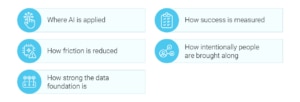
The number of AI tools deployed says very little about whether an AI program is working. The more useful test is whether the technology fits the workflow, the underlying data can support it, and the team can point to a measurable result.
Time Saved Doesn’t Always Become Capacity
AI is saving time across familiar service desk tasks. Respondents report weekly time savings in activities including:
- Detecting and flagging issues: 3.3 hours
- Responding to end-user requests: 3.0 hours
- Triaging and categorizing tickets: 2.9 hours
- Creating or uploading knowledge base articles: 2.9 hours
- Documenting and summarizing incidents: 2.8 hours
- Resolving and remediating issues: 2.7 hours
AI is improving individual tasks, but it is not always reducing total workload. Fifty-two percent of respondents say their workload has increased since adopting AI, while another 19% say it has stayed about the same. In other words, ticket-level efficiency is not automatically creating free capacity. Faster triage, drafting, summarization, and knowledge creation can create room for teams to take on more requests, improve documentation, pursue proactive work, or support a larger business. Leadership needs to see where that reclaimed time is going and whether it is improving service outcomes.
A service desk that resolves tickets faster but absorbs more demand may be more productive. It may also feel just as busy. Without outcome-based measurement, those two realities can be difficult to distinguish between.
The AI Maintenance Tax is Real
The report’s clearest warning is that AI work does not end when a tool goes live.
Nearly three-quarters of respondents spend at least three hours a week on AI maintenance. Forty-four percent spend more time maintaining AI than they do using its output. AI maintenance also requires meaningful time: 83% of respondents report spending at least three hours per week on maintenance, including 44% who spend six or more hours.
Teams report spending time managing and maintaining AI tools, reviewing and validating AI-generated output, training and fine-tuning models, and addressing data-quality gaps. Forty-eight percent spend time managing or maintaining AI tools, while 47% spend time reviewing and validating AI-generated content.
AI does not become self-sustaining once it goes live. Teams need to review outputs, keep knowledge current, monitor data quality, and decide who owns ongoing changes. Without that operating model, manual effort can move from completing work to checking, maintaining, and correcting it. Treat AI as an operational service, not a one-time implementation. Assign ownership, track maintenance time, identify where human review is required, and build knowledge and data-quality work into the plan from the beginning.
Measure Outcomes, Not Activity
The measures a team chooses can change whether AI feels like an advantage or another source of work. The survey found that teams using activity-based metrics are 2.4 times more likely to report increased workload than teams that measure outcomes. Activity metrics such as tickets processed, tasks completed, and AI interactions can show use. They cannot, on their own, show whether the service experience improved, efficiency increased, or a business result changed.
The greatest improvements reported are tied to outcomes that matter beyond the service desk:
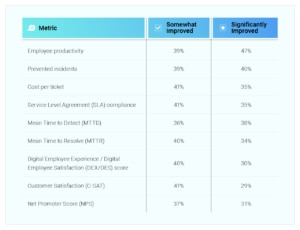
The 2024 and 2025 reports also showed measurable efficiency gains when teams applied automation, self-service, knowledge management, and GenAI to structured service desk work. The 2026 research adds a harder requirement: IT leaders need to show that those efficiency gains are improving an outcome the business recognizes.
What IT Leaders Should Do Next
The findings do not point to one answer: deploy more AI. They point to a more disciplined approach to the AI already in use.
- Focus first on workflows that are frequent, repeatable, and measurable.
Ticket categorization, issue detection, end-user request handling, incident summaries, and knowledge creation are strong candidates because the baseline work is visible and the impact is trackable.
- Include maintenance in the business case from the start.
If a workflow requires extensive model tuning, validation, and data cleanup, include that time in the business case. A more modest use case with lower overhead may create better net value than a broad deployment that requires constant attention. - Set outcome measures before implementation.
Measure outcomes such as resolution time, SLA attainment, deflected tickets, incident prevention, employee productivity, and cost per ticket. Those measures give IT leaders a way to explain whether AI is reducing friction or simply redistributing work.
The 2026 State of ITSM Report draws on responses from 844 IT professionals. It examines where AI is saving time, where its maintenance burden is substantial, and how IT professionals can measure whether that work is improving the outcomes their organizations care about.
To dive deeper into the data, download the 2026 State of ITSM Report.
Discover how SolarWinds Service Desk or our self-hosted option, Web Help Desk, can help your organization reach its service goals.
You may also like