AI can speed up service desk work. It can also make the service desk busier, create new maintenance work, and expose weak data and unclear metrics.
That is the central takeaway from SolarWinds 2026 State of ITSM Report, based on a survey of 844 IT professionals. The results do not argue against AI. They show that AI value depends on how it is applied, maintained, measured, and supported by the people and data behind it.
Here are five key findings that should shape how you run the service desk this year.
1. Most teams see ROI, but few see a breakthrough
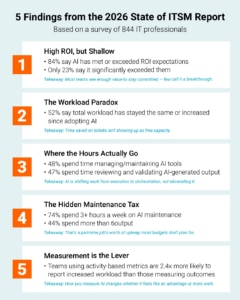
Eighty-four percent of respondents say AI has met or exceeded ROI expectations. That is a solid result, especially after years of experimentation and inflated expectations around generative AI.
Still, only 23% say AI has significantly exceeded expectations.
The difference matters. It suggests that many service desks have found practical uses for AI, but they have not yet translated those uses into outsized gains. Respondents report gains across practical uses such as drafting responses, summarizing tickets, categorizing requests, and surfacing knowledge. Those are worthwhile improvements. But they do not automatically change the economics or experience of service delivery.
What this means for your service desk: Stop using AI adoption as the headline metric. Identify the service outcomes the technology should improve, then decide whether it is doing so. Examples include fewer escalations, stronger SLA compliance, shorter resolution times, lower cost per ticket, higher employee satisfaction, or more incidents prevented.
2. Time savings are real, but workload may not go down
Survey respondents report that AI saves time across several core service desk tasks:
The results reinforce earlier SolarWinds research. The 2024 State of ITSM Report found that customers using automation resolved incidents about three hours faster on average. Self-service portals were associated with a reduction of just over two hours, while customers using knowledge base articles resolved incidents about six hours faster.
These comparisons are observational, and the report notes that the self-service result is heavily skewed because portal adoption was already above 95%. The 2025 State of ITSM analysis found that average incident resolution time among organizations using GenAI-enabled SolarWinds Service Desk features fell from 27.42 hours before enablement to 22.55 hours afterward, a difference of 4.87 hours, or 17.8%. This was an observational before-and-after analysis of customer data, not a controlled experiment.
|
Task |
Average time respondents report AI saves per week |
|
Detecting and flagging issues |
3.3 hours |
|
Responding to end-user requests |
3.0 hours |
|
Triaging and categorizing tickets |
2.9 hours |
|
Creating or uploading knowledge base articles |
2.9 hours |
|
Documenting and summarizing incidents |
2.8 hours |
|
Resolving and remediating |
2.7 hours |
Yet 52% of respondents say their overall workload increased after adopting AI, while another 19% say it stayed about the same. Combined, 71% report no reduction in workload.
What this means for your service desk: Do not promise that every hour saved will reduce headcount needs or create idle capacity. Service desks often reinvest reclaimed time in more requests, better documentation, proactive maintenance, knowledge improvements, and strategic projects. That may be a sign of progress, but leadership needs visibility into where the time is going.
3. AI adds oversight work alongside execution
AI may reduce the time required to complete individual tasks, but it creates new work around quality control and operations.
Forty-eight percent of respondents spend time managing or maintaining AI tools. Another 47% spend time reviewing and validating AI-generated output. That means IT teams are not simply handing work to AI and moving on. They oversee the technology, check results, refine processes, and manage the information that supports it.
This is especially relevant for service desks, where a poor response, inaccurate summary, or incorrect categorization can slow down resolution rather than speed it up.
What this means for your service desk: Design human review into workflows that carry real risk. Define when AI output can be used automatically, when it needs agent approval, and who is responsible for auditing quality. The goal is not to eliminate human judgment. It is to apply it where it has the greatest value.
4. The AI maintenance tax needs a budget
Eighty-three percent of respondents spend at least three hours per week on AI maintenance. Forty-four percent spend six or more hours per week on AI maintenance activities such as prompt tuning, output review, and vendor coordination.
That maintenance can include updating knowledge sources, reviewing prompts and outputs, tuning models, handling integrations, monitoring adoption, addressing data gaps, and training users. Teams that want AI to remain reliable need to plan for this work as part of the operating model.
The issue is not that AI requires maintenance. Every important service desk capability does. Automation rules need review. Knowledge articles go stale. Self-service portals need governance. The difference is that many organizations have already built processes around those systems, while their AI operating model is still emerging.
What this means for your service desk: Put AI maintenance on the roadmap. Assign accountable owners, define review cycles, track the effort involved, and include it in the cost and capacity model. A use case that produces modest gains with low maintenance may be more valuable than a high-profile deployment that creates ongoing operational drag.
5. Outcome metrics change the experience of AI
Organizations using an activity-oriented measurement approach are 2.4 times as likely to report increased workload as organizations using an outcome-oriented approach.
This finding should change the way leaders evaluate service desk AI. Counting AI-generated summaries, automated categorizations, or tickets processed can show usage, but not value. A service desk can complete more activities and still leave employees waiting, agents overloaded, or costs rising.
The survey points to more useful measures, including employee productivity, prevented incidents, cost per ticket, SLA compliance, mean time to detect, mean time to resolve, DEX/DECS score, customer satisfaction, and Net Promoter Score.
What this means for your service desk: Pick a small number of outcome measures for every AI use case. For example, if AI helps triage tickets, measure reassignment rates, time to assignment, SLA compliance, and resolution time. If AI helps with knowledge, measure ticket deflection, article helpfulness, repeat incidents, and agent time spent searching for answers.
Run AI as part of ITSM
The 2026 State of ITSM Report points to a more mature approach to AI in the service desk. The question is no longer whether AI belongs in ITSM. The question is whether the service desk has the workflows, data, measurement, and operating discipline to use it well.
The 2024 report showed that automation, self-service, knowledge, and SLA management create a strong efficiency foundation. The 2025 report showed that GenAI can build on that foundation and reduce incident resolution time. The 2026 research makes the next step clear: sustainable AI value comes from managing the work around AI as deliberately as the AI itself. Download the 2026 State of ITSM Report to learn more. If you’re interested in exploring service desk features for yourself, discover our SaaS and on-premise options.
* The 2026 State of ITSM Report is based on an online survey of 844 qualified IT professionals across North America, EMEA, and APAC. Individual questions received different numbers of responses, so question-level sample sizes vary. The 2024 and 2025 comparisons cited here come from separate SolarWinds customer data analyses and should not be read as results from the 2026 survey.