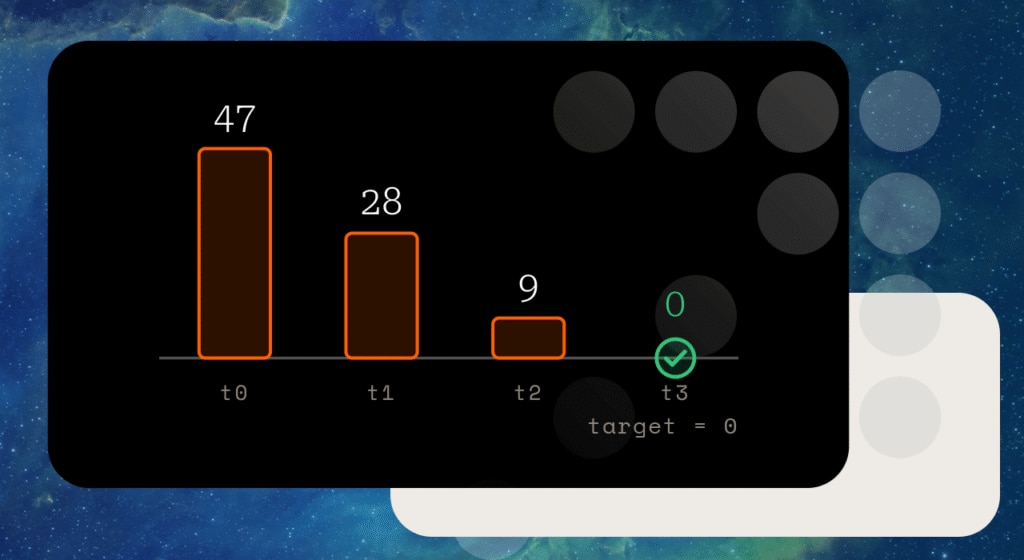

Imagine if, instead of giving AI one instruction after another, you could tell it what you’re trying to achieve? That sounds like a small change in language. But it could represent a much bigger change in how IT teams use AI.
Goal-oriented AI uses role-based AI agents to work toward defined outcomes rather than simply completing isolated tasks. For IT operations teams exploring agentic AI, it represents a shift from telling AI what to do step by step to defining what you want to achieve — and the guardrails it must operate within and having it pursue the goal.
Rather than asking AI to summarize an alert, recommend a troubleshooting step, or explain an anomaly, you define the outcome you want:
- Reduce unnecessary alert noise without losing visibility into critical issues.
- Identify the likely cause of service degradation and determine the safest path to resolution.
- Maintain healthy service performance within defined operational guardrails.
AI agents can then work out which tasks are needed to move toward that goal, operate within the boundaries you set, check whether their actions are helping, and adapt when needed.
That’s the idea behind goal-oriented AI.
This guide explains what goal-oriented AI is, how it works, how it differs from generative and agentic AI, and what it could mean for IT operations.
Everything you need to know about goal-oriented AI
- What is goal-oriented AI?
- How does goal-oriented AI work?
- Is goal-oriented AI the same as agentic AI?
- Why does goal-oriented AI matter for IT operations?
- What does goal-oriented AI look like in IT operations?
- What’s the difference between a task and a goal?
- Does goal-oriented AI mean autonomous IT?
- How can IT teams prepare for goal-oriented AI?
- Goal-oriented AI FAQs
What is goal-oriented AI?
Goal-oriented AI is an approach in which people define the desired outcome, set the guardrails, and determine the level of authority AI has. AI agents then plan and coordinate the work needed to move toward that outcome, take permitted actions, evaluate progress, and adapt their next steps.
The important difference is that the AI is working toward a result rather than simply completing one isolated instruction. Here is a simple example.
You could ask an AI assistant:
Which of these alerts should I investigate first?
That is a task.
Or you could define a goal:
Reduce unnecessary alert noise without losing visibility into critical issues.
Now the AI has an outcome to work toward.
Depending on the system and the permissions you provide, AI agents could gather evidence, correlate related events, identify patterns, determine what needs attention, recommend or take permitted actions, and check whether those actions improved the situation.
That last part matters.
Completing an action and achieving an outcome are not the same thing. If the task was completed but the operational state did not improve, the goal has not been achieved.
How does goal-oriented AI work?
At its simplest, goal-oriented AI needs three things:
Goal. Guardrails. Feedback.
1. The goal
The goal defines what you are trying to achieve. For example:
Investigate these alerts = activity.
Reduce non-actionable alert noise while maintaining visibility into critical issues = outcome.
A clearly defined outcome gives AI something against which it can evaluate its work.
Instead of asking only:
Did I complete the task?
The system can also ask:
Did that task move us closer to the desired outcome?
2. The guardrails
Guardrails define what AI is allowed to do while pursuing the goal.
They can determine:
- Which systems AI can access
- Which data it can use
- Which actions it can take independently
- Which actions require human approval
- Which actions or systems are off limits
- When AI should stop and escalate to a person
Different goals can have different levels of autonomy.
An organization may allow AI to investigate and recommend independently, for example, while requiring approval before changes are made to a production environment.
3. The feedback
Feedback tells the system whether its actions are helping. An AI agent may successfully perform an action without improving the operational outcome. If performance worsens rather than improves, for example, the goal has not been achieved.
A goal-oriented system can use feedback to reassess the situation, adapt its approach, try another permitted path, or escalate to a person.
That feedback loop matters because IT operations rarely follow a perfectly predictable sequence.
Is goal-oriented AI the same as agentic AI?
Goal-oriented AI and agentic AI are related, but they are not the same.
AI terminology continues to evolve, so the boundaries can be blurry. A useful way to think about the difference is:
| AI Approach | What you provide | What the AI does |
| Generative AI | A prompt | Generate and answer, explanation, or other content |
| Agentic AI | A task or objective | Reasons, plans, uses tools, and carries out multiple steps |
| Goal-oriented AI | An outcome and guardrails | Coordinates actions toward an outcome and evaluates progress |
Generative AI is largely about producing something. Agentic AI introduces the ability to reason, plan, use tools, and take actions across several steps. Goal-oriented AI uses those agentic capabilities in service of a defined outcome. Instead of saying:
Do X. Then: Now do Y. Then: Check Z.
You are saying: Here is the outcome I want. Here are the boundaries. Work toward it.
Agentic AI provides much of the how.
Goal-oriented AI gives that activity a defined why.
For IT operations, that distinction can be significant.
Why does goal-oriented AI matter for IT operations?
IT teams rarely have a shortage of information. Usually, the problem is the opposite.
Alerts. Logs. Metrics. Traces. Events. Tickets. Changes. Dependencies. Dashboards.
The challenge is turning all that information into understanding, turning understanding into a decision, and turning that decision into action. AI for IT operations already helps with individual parts of that process. It can:
- Summarize large volumes of operational data
- Highlight patterns and anomalies
- Explain technical information
- Suggest likely causes
- Recommend what to investigate next
- Help operators navigate complex environments
But the IT professional is often still acting as the operator. They decide:
- Which question to ask
- How to interpret the answer
- What to investigate next
- Which tool or system to open
- Whether action is required
- Whether the action worked
Goal-oriented AI has the potential to change that operating model and move them from operator to orchestrator. Instead of helping with one isolated task at a time, AI agents for IT operations can coordinate several steps toward an operational outcome.
The human still defines the destination. The human still defines the boundaries. But the human does not necessarily need to direct every step along the way
What does goal-oriented AI look like in IT operations?
The easiest way to understand goal-oriented AI is to look at the outcomes IT teams already care about.
Reduce alert noise without hiding important signals
Nobody starts the day thinking, “My goal is to process 400 alerts.”
The actual goal is closer to: “Show me what needs attention before it affects the business”.
Traditional monitoring can trigger alerts. Automation can route or suppress them according to predefined rules. Generative AI can summarize them.
A goal-oriented approach can go further by working toward the desired operational state: reducing unnecessary noise while protecting the signals that matter.
AI agents could:
- Correlate related events
- Gather supporting evidence
- Identify recurring patterns
- Determine which conditions warrant attention
- Recommend or take permitted actions
- Evaluate whether the signal-to-noise ratio is improving
The goal is not to process alerts faster. It is to reduce the manual attention required for alerts that do not need it.
Get from “something’s wrong” to “here’s why” faster
A service slows down. Where do you start? The network? Application? Database? Infrastructure? A recent change? An external dependency? In a complex hybrid IT environment, finding the answer can mean moving between several tools and testing one hypothesis after another. AI can already help at individual stages of that investigation.
Goal-oriented AI changes the assignment. Instead of asking a sequence of separate questions, you could define an outcome such as:
Identify the likely cause of this degradation and determine the safest path toward resolution.
AI agents can then gather evidence, investigate likely causes, eliminate dead ends, determine what should happen next, and escalate when human judgment is required. The operator moves from orchestrating every stage of the investigation toward overseeing the outcome.
Stay ahead of resource problems
Threshold-based monitoring remains useful.
CPU reaches X.
Storage hits Y.
Utilization exceeds Z.
Alert someone.
But creating the alert is not the operational outcome. Keeping the service healthy is.
A goal-oriented approach could focus instead on maintaining a desired operational state. That might involve assessing:
- Current utilization
- Historical patterns
- Dependencies
- Business impact
- Recent changes
- Available capacity
The system could then recommend or, where permitted, take action before users feel the effect.
The threshold is a signal. The healthy service is the goal.
What’s the difference between a task and a goal?
A useful way to distinguish a task from a goal is to ask whether you are telling AI what to do or what you want to achieve.
|
If you ask AI to… |
You are probably giving it… |
|
Summarize these alerts |
A task |
|
Identify likely root causes |
A task |
|
Recommend the next troubleshooting step |
A task |
|
Explain this performance anomaly |
A task |
|
Reduce non-actionable alert noise without hiding critical signals |
A goal |
|
Keep this service within defined performance parameters |
A goal |
|
Restore healthy performance within these operational guardrails |
A goal |
|
Reduce time spent manually investigating recurring issues |
A goal |
Tasks still matter. They are how work gets done. The difference is that, with goal-oriented AI, individual tasks become steps toward a larger desired state. The system is not just completing a list. It is coordinating work toward an outcome.
The real shift: from instructions to intent
For decades, technology has expected people to tell it what to do.
Click this.
Run that.
If X happens, do Y.
Enter a prompt.
Goal-oriented AI starts somewhere else:
What are you trying to achieve?
That changes the relationship between the operator and the technology. Instead of specifying every move, the person defines:
- The desired outcome
- The constraints
- The permissions
- The points where human judgment is required
AI agents can then coordinate the tasks in between. People have not disappeared from the process. Their role shifts from directing every task toward governing the overall outcome.
Does goal-oriented AI mean autonomous IT?
No. Goal-oriented AI does not mean giving AI unrestricted control over an IT environment. There is an important difference between: AI can take action and AI can take any action it wants.
Goal-oriented AI should operate within defined permissions and guardrails. An IT team might allow AI agents to:
- Collect data
- Correlate events
- Investigate likely causes
- Recommend next steps
- Take defined low-risk actions
Other actions may remain tightly controlled. For example:
- A production change might require approval
- An unfamiliar situation might trigger an escalation
- Sensitive systems might remain off limits
- High-risk actions might always require human intervention
Different organizations will draw those boundaries in different places. They may even use different guardrails for different environments, roles, systems, or operational goals. That is not a weakness of goal-oriented AI. It is part of making autonomy usable in real IT environments.
How can IT teams prepare for goal-oriented AI?
Start with the work. Look for processes where your team repeatedly moves between signals, systems, tools, and decisions. Then ask a few practical questions.
- What outcome are we trying to achieve?
Go beyond the activity. Instead of: We need to triage alerts faster. Ask: Why”
The real objective might be: Reduce the time engineers spend determining which alerts are actionable. That gives you something much more useful to optimize.
- Can we tell when we have succeeded?
A vague objective is not particularly useful to either a person or an AI. Define what good looks like. Ask:
- What should improve?
- What should remain protected?
- What should not change?
- What would indicate that the goal has been achieved?
- What would indicate that the system is moving in the wrong direction?
- What can AI safely handle?
Separate investigation, recommendation, and action. You may be comfortable allowing AI to investigate independently while keeping changes human-approved. Over time, you might allow certain low-risk actions to happen automatically. The important thing is that those boundaries are intentional.
- Where should a human make the decision?
Build approval and escalation points into the process from the beginning. Human intervention is not a failure of automation. Sometimes it is exactly how the system should work.
- Does AI have enough context?
IT problems rarely exist in isolation. Applications depend on infrastructure. Infrastructure depends on networks. Changes can have effects far beyond the system where they originated. AI needs context to understand those relationships. That makes connected operational data and a strong observability strategy increasingly important.
The better AI understands what is happening across the environment, the better equipped it is to investigate causes, evaluate impact, and determine what should happen next.
- Where can we start small?
“Let AI autonomously run the entire IT environment” is probably not the best first use case. Choose one focused and measurable outcome. Learn where AI helps. Learn where human judgment is still required.
Adjust the guardrails. Then expand.
If you are thinking about where your organization sits today and what moving toward more goal-oriented operations might look like, start with the journey rather than the technology. Here’s a useful guide to help you get started.
Get the AI evolution guide: From Intelligent Monitoring to Goal-Oriented AI
How can I try goal-oriented AI?
SolarWinds® Avior™ is goal-oriented agentic AI for IT operations.
It is designed to let IT teams define the outcome they want to achieve and establish the guardrails within which AI can work. Rather than managing AI one prompt or task at a time, users can define a goal and determine how much authority AI has. Role-based AI agents can then:
- Gather evidence
- Coordinate work
- Recommend next steps
- Take permitted, risk-gated actions within the user’s permissions
- Record their activity
- Verify results
- Adapt when the situation changes
- Hand work back to a person when they reach the limits of what they should do independently
You remain in control of the goal.
You remain in control of the guardrails.
You determine where human judgment is required.
Three capabilities are what make that possible.
- Goal-oriented: A control loop toward a measurable target. Progress is numeric, and a goal completes only when every metric reads achieved.
- Transparent: Shows its reasoning in language you understand, every step auditable — including its own corrections.
- Controlled: You decide what it can do at every level. Autonomy rises only as results prove out, and never exceeds your ceiling.
All three run on twenty-five years of SolarWinds data and operational expertise.
From asking for answers to directing outcomes
The first wave of generative AI made getting answers dramatically easier. That matters. But an answer is rarely the end of an IT problem.
Someone still has to understand what it means, decide what to do next, take action, and determine whether the situation improved. Goal-oriented AI moves that conversation forward.
How can IT teams prepare for goal-oriented AI?
The best place to start is not necessarily buying more AI. Start with the work. Look for processes where your team repeatedly moves between signals, systems, tools, and decisions. Then ask a few practical questions.
What outcome are we trying to achieve?
Go beyond the activity. Instead of: We need to triage alerts faster. Ask: Why?
The real objective might be: Reduce the time engineers spend determining which alerts are actionable.
That gives you something much more useful to optimize.
Can we tell when we have succeeded?
A vague objective is not particularly useful to either a person or an AI. Define what good looks like. Ask:
- What should improve?
- What should remain protected?
- What should not change?
- What would indicate that the goal has been achieved?
- What would indicate that the system is moving in the wrong direction?
What can AI safely handle?
Separate investigation, recommendation, and action. You may be comfortable allowing AI to investigate independently while keeping changes human-approved. Over time, you might allow certain low-risk actions to happen automatically. The important thing is that those boundaries are intentional.
Where should a human make the decision?
Build approval and escalation points into the process from the beginning. Human intervention is not a failure of automation. Sometimes it is exactly how the system should work.
Does AI have enough context?
IT problems rarely exist in isolation. Applications depend on infrastructure. Infrastructure depends on networks. Changes can have effects far beyond the system where they originated. AI needs context to understand those relationships. That makes connected operational data and a strong observability strategy increasingly important.
The better AI understands what is happening across the environment, the better equipped it is to investigate causes, evaluate impact, and determine what should happen next.
Where can we start small?
“Let AI autonomously run the entire IT environment” is probably not the best first use case. Choose one focused and measurable outcome. Learn where AI helps. Learn where human judgment is still required.
Adjust the guardrails. Then expand.
Understand your next step
If you are thinking about where your organization sits today and what moving toward more goal-oriented operations might look like, start with the journey rather than the technology.
CTA: Read From Intelligent Monitoring to Goal-Oriented AI
Where does Avior fit?
SolarWinds® Avior™ is goal-oriented agentic AI for IT operations.
It is designed to let IT teams define the outcome they want to achieve and establish the guardrails within which AI can work. Rather than managing AI on a per-prompt or per-task basis, users can define a goal and determine how much authority to grant AI. What changes is how much of the work between “here is what I need” and “here is the outcome” has to be manually orchestrated.
Instead of:
Help me complete this task. The conversation becomes: Here is the outcome I need.
That is where goal-oriented AI starts to change the way IT teams can work.
 https://www.solarwinds.com/avior
Goal-Oriented AI FAQs
What is goal-oriented AI?
Goal-oriented AI is an approach in which AI works toward a defined outcome rather than simply completing isolated tasks.
Users define the goal and guardrails. AI agents can then plan and coordinate the steps needed to make progress, perform permitted actions, evaluate the result, and adapt their approach.
How does goal-oriented AI work?
Goal-oriented AI typically combines three elements: a defined goal, operational guardrails, and feedback.
The goal establishes the desired outcome. Guardrails determine what AI is allowed to do. Feedback helps the system evaluate whether its actions are moving it closer to the goal.
What is the difference between goal-oriented AI and generative AI?
Generative AI typically responds to a prompt by producing content such as an answer, summary, explanation, or recommendation.
Goal-oriented AI starts with a desired outcome. AI agents can then carry out multiple tasks, evaluate progress, and adjust their approach as they work toward that outcome.
Is goal-oriented AI the same as agentic AI?
Goal-oriented AI and agentic AI are closely related.
Agentic AI generally refers to systems that can reason, plan, use tools, and take actions with some degree of independence.
Goal-oriented AI uses those capabilities in pursuit of a defined outcome.
How can AI agents help IT teams?
Depending on their role and permissions, AI agents can help IT teams gather information, correlate events, investigate likely causes, recommend next steps, take permitted actions, and evaluate whether those actions improved the desired operational outcome.
Is goal-oriented AI autonomous?
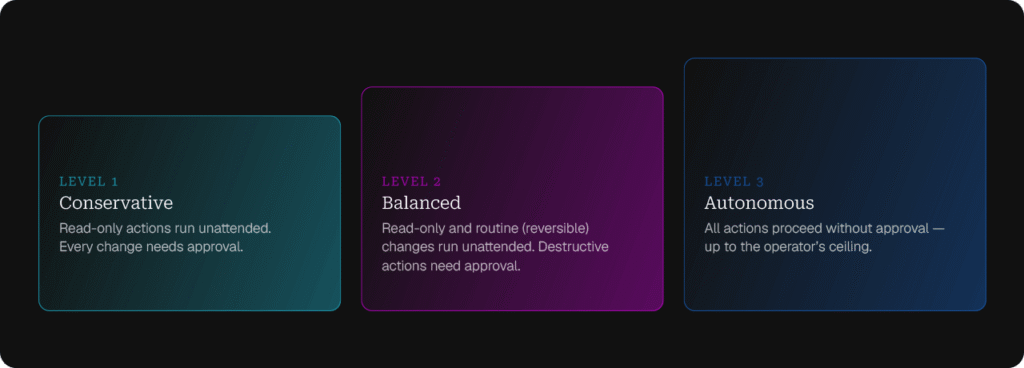
Goal-oriented AI can support different levels of autonomy. What are these levels of autonomy? SolarWinds® Avior™ autonomy levels define how much approval the agent requires before taking any action:
Conservative: Read-only investigation and analysis run without approval. Every environment change requires human approval.
Balanced: Read-only and routine, reversible changes can run automatically. Destructive or potentially high-impact changes require approval.
Autonomous: Permitted actions can proceed automatically within the organization’s configured policies and limits. Actions outside those limits or requiring human judgment still require approval.
The effective autonomy is always the lowest setting across the organization, agent, and goal. Teams can start conservatively and increase autonomy as trust is established.
How independently an AI agent can operate depends on the permissions, policies, and guardrails established by the organization.
Some activities may happen automatically. Others may require approval or remain entirely human-led.
What are examples of goal-oriented AI in IT operations?
Potential examples include:
- Reducing non-actionable alert noise
- Accelerating incident investigations
- Maintaining service health
- Identifying emerging capacity risks
- Improving configuration quality
- Reducing manual work associated with recurring operational issues
What makes these goals rather than tasks is that success is measured by the operational outcome, not simply by whether an individual action was completed.
Why is observability important for goal-oriented AI?
Goal-oriented AI depends on context. IT environments contain interconnected applications, infrastructure, networks, services, dependencies, and changes. Observability can provide the operational context AI needs to understand relationships across that environment, investigate what is happening, evaluate impact, and make better-informed decisions.



