

More observability tools don’t guarantee more visibility. When an incident crosses applications, networks, cloud environments, and infrastructure, teams can spend valuable time switching between tools and reconstructing context instead of resolving the problem. New independent research from Enterprise Management Associates (EMA) explores how organizations are addressing that challenge through observability unification. The study surveyed 356 enterprise IT professionals directly involved in observability unification initiatives.
The findings point to a broader shift: observability unification is becoming less about consolidating everything into one platform and more about connecting the data, tools, teams, and workflows needed to understand what is happening and act on it. The goal is shared operational context—not fewer tools.
The research at a glance:
- 97% say observability unification is strategically important.
- 56% say operators switch tools three to five times during a major incident investigation.
- 3% cite improved collaboration across teams as a benefit of unification.
- 8% cite faster mean time to resolution.
- 1% say their biggest mistake was underestimating integration complexity.
What does observability unification mean?
Observability environments rarely become fragmented by design. Different teams adopt tools to meet the monitoring, reporting, alerting, and operational requirements of their domains. As a result, organizations often rely on separate, discipline-specific tools across networking, applications, cloud, infrastructure, security, and service management.
Those tools can work well individually. The challenge begins when an issue crosses domains. Observability unification connects the tools, data, workflows, and operational context teams need to understand and resolve issues across the environment. It does not necessarily mean replacing every monitoring tool with a single platform. This makes observability unification broader than traditional tool consolidation. It can involve integrating existing tools, sharing data across systems, establishing common standards, connecting observability with service workflows, and using AI to correlate information across domains.
Tool sprawl creates more than a tooling problem
Most organizations in the EMA study use between four and 12 monitoring and observability tools. None had consolidated everything into a single tool. That might not matter if every tool operated in isolation. During a major incident, teams often need to piece together information from several systems before they can determine the cause and response.
Nearly 56% of respondents said operators switch between tools three to five times while investigating a major incident. Among organizations using 13 or more tools, 26% reported switching six to ten times. That context switching creates more than inconvenience. Respondents linked tool sprawl to skills and staffing pressure, integration complexity, slower investigations, additional manual work, alert noise, and increased risk of burnout. The impact also reaches the business. Organizations associated tool sprawl with higher total cost of ownership, slower incident detection and resolution, inconsistent data, and weaker end-to-end visibility.
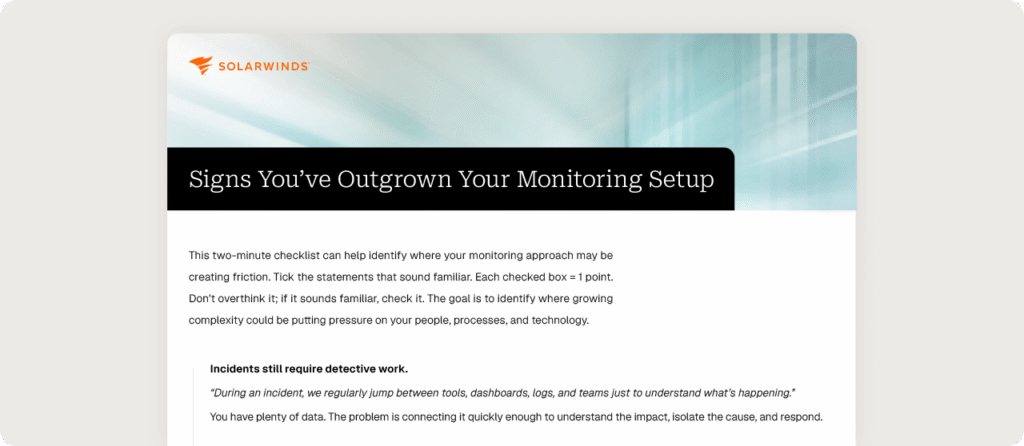
Use this two-minute checklist to see whether growing monitoring complexity is creating friction for your teams:
Unification doesn’t necessarily mean one tool
Observability unification doesn’t require every team to give up the specialist tools it relies on.
In the study, organizations expressed concerns about wholesale tool replacement, including the loss of specialist capabilities, disruption to existing workflows, reduced customization, and vendor lock-in. The research points toward integration and shared context rather than replacing every tool with one platform. EMA asked organizations to assess several potential paths to observability unification. Two stood out: integrating tools through APIs, data sharing, and common standards, and using AI-powered correlation to connect visibility across tools. Cross-tool data sharing and a common data foundation were also among the leading integration priorities.
So, the goal isn’t necessarily: One platform that does everything. It’s: Enough shared context for teams to understand what’s happening and work together effectively and efficiently.
For organizations beginning that journey, a more practical starting point than enterprise-wide consolidation may be a high-impact incident or service workflow. Look for where teams lose context, switch systems, or repeat manual work. That is where unification can start to make a measurable difference. Organizations aren’t pursuing observability unification simply to reduce software costs. When EMA asked what was driving unification, the leading business requirements included faster mean time to resolution, better collaboration across IT, and improved IT staff productivity.
The benefits respondents had achieved—or expected to achieve—tell a similar story:
- 3% cited improved collaboration across teams.
- 8% cited faster mean time to resolution.
- 7% cited increased engineering productivity, including fewer hours spent investigating each incident.
Cost savings matter too. But collaboration came out on top.
That points to what observability unification is really changing. It isn’t simply making the monitoring estate tidier. It is reducing the gaps between the people, data, and workflows involved in understanding and resolving an issue. A useful measure of progress is whether the people responding to an incident can see and act on the same context Almost half of respondents(49.7%) said AI transformation was motivating their organization to consider unifying observability tools, slightly ahead of hybrid and multi-cloud architecture at 47.2%. But the research also offers an important warning: AI doesn’t eliminate fragmentation.
EMA found that more mature AI adoption was associated with more mature unification, stronger service impact mapping, deeper ServiceOps integration, and more mature incident automation. The relationship is important because AI can amplify an operating model that already has unified data, workflows, and operational context. Data quality illustrates the point.
Only 8% of respondents believed AI could effectively bridge fragmented data without unification being a prerequisite. Most said AI either requires unified data or works better when data is unified. The implication is straightforward: AI readiness isn’t only an AI question. It is also a question of data, context, workflow, and governance.
Before asking AI to make sense of an IT environment, organizations need to consider whether it has access to enough reliable context to understand that environment in the first place.
What can derail observability unification?
Knowing that systems need to work together doesn’t make connecting them simple. Integration complexity was the leading obstacle identified in the research, followed by data silos and incompatible formats, skills gaps, cost justification, and difficulty agreeing on shared metrics and data standards. One finding stands out. When respondents were asked about the biggest mistake their organization had made during observability unification, 33.1% chose underestimating integration complexity. That was more than three times the rate of any other individual answer. There’s a practical lesson in that unification should start with solving the operational problem—not with the assumption that everything needs to be consolidated or connected.
Start with a workflow that matters:
Where does context get lost?
Where are teams switching tools?
Where is information being manually reconstructed?
Where does collaboration slow down?
Then identify which data, integrations, and workflows need to come together to improve it.
What does a more mature observability strategy look like?
EMA frames successful observability initiatives across:
- Visibility: understanding what is happening across the environment.
- Integration: connecting tools and data across domains.
- Operational context: understanding relationships, dependencies, and service impact.
- ServiceOps: connecting technical insight with service management and operational workflows.
- AI-enabled operational execution: applying AI and automation using shared operational context.
The important point isn’t simply reaching the final stage. It’s recognizing that each stage builds on what comes before it. The research links stronger operational performance with clearer governance, engineering expertise, deeper ServiceOps integration, shared operational context, automation, and more mature use of AI.
Beyond tool sprawl: toward connected IT operations
Observability unification is not forcing every team onto the same tool. It’s about giving teams enough shared operational context to understand what’s happening, collaborate quickly, and act with confidence. That helps explain why 97% of respondents said observability unification was strategically important to their organization.
The organizations with more mature approaches aren’t simply reducing tool counts. They’re connecting observability with workflows, service context, governance, automation, and AI. And that brings us back to the question at the heart of the research. It’s not how much your tools can see. It’s how effectively your organization can turn what they see into action.
See what 356 IT professionals reveal about observability unification
The findings here are only part of the picture. The full EMA research explores tool sprawl, observability maturity, ServiceOps, AI adoption, automation, governance, integration strategies, common roadblocks, and the outcomes organizations associate with more unified operations. Download the full EMA report, The Reality of Observability Unification in Modern IT Operations, to explore the research behind these findings, understand the stages of observability maturity, and see how organizations are approaching more connected IT operations.
Learn more about SolarWinds Observability
About the report
Enterprise Management Associates conducted the research from May to June 2026, surveying 356 IT professionals directly involved in observability unification initiatives. The study included organizations across North America and EMEA and examined how enterprises are approaching observability tool integration, consolidation, governance, ServiceOps, AI, and automation