

What is SAP HANA architecture?
SAP HANA is a multi-model, in-memory, column-oriented database that supports transactional and analytical processing in one system.
When teams discuss SAP HANA architecture, they are usually referring to two related areas:
-
Internal database services, including the index server and calculation engine
-
Deployment design across scale-up, scale-out, on-premises, and cloud environments
Together, these elements determine how the platform stores data, processes queries, scales, and recovers from failure.
Core SAP HANA components
Index server
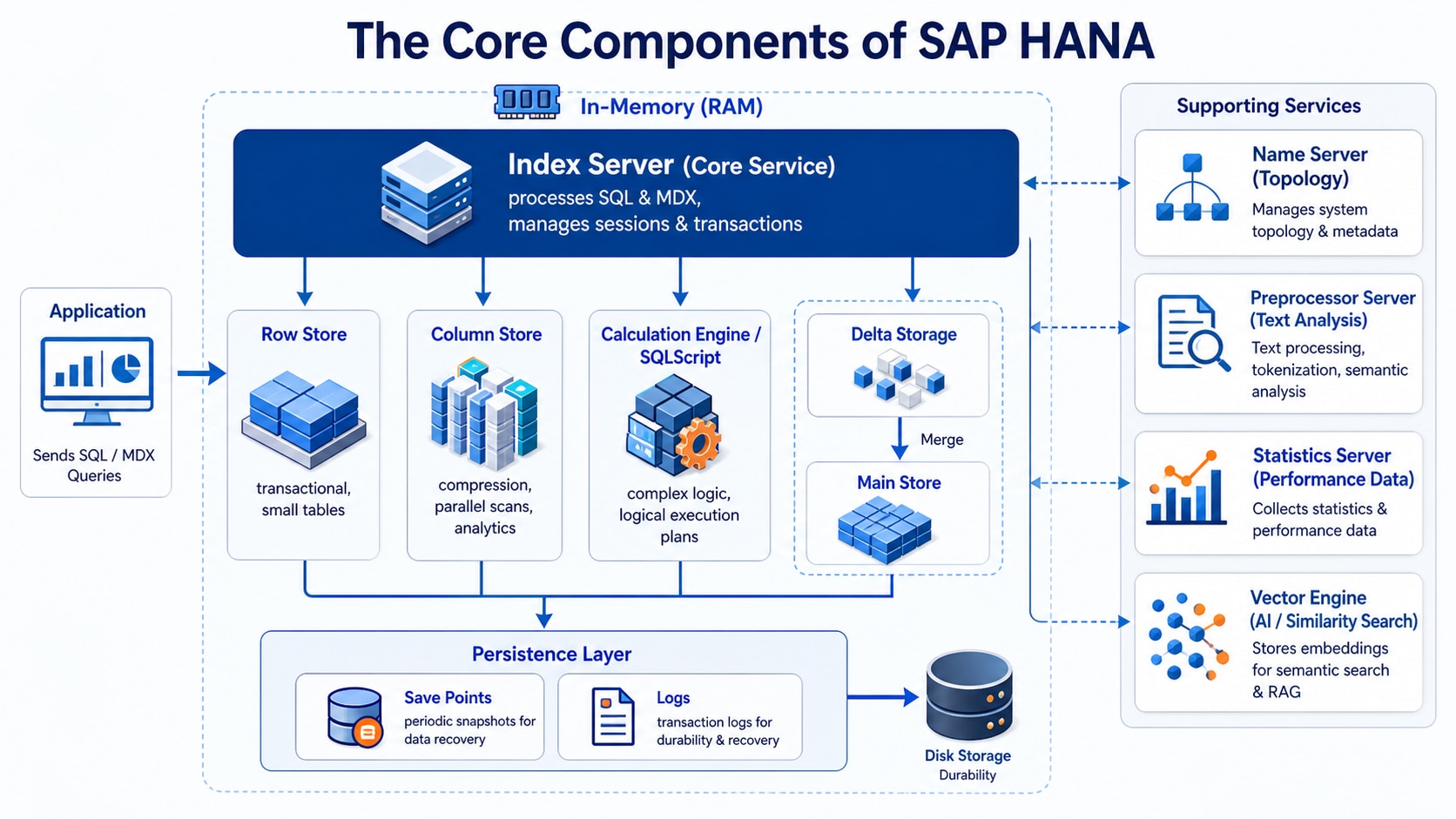
The index server is SAP HANA’s core service. It processes SQL and MDX requests, manages sessions and transactions, and coordinates the engines that execute the work.
Row store and column store
SAP HANA includes both row and column stores. Most performance discussions focus on the column store because it supports compression, parallel scans, and analytical processing at scale.
The row store remains useful for smaller, highly transactional workloads and certain system tables. The right storage choice depends on the workload, not simply on the database platform.
Calculation engine, SQLScript, and plan generation
The calculation engine handles more complex logic. SQLScript, calculation models, and other advanced requests can be transformed into a logical execution plan that the execution engine can optimize and run in parallel.
This means query performance depends on more than hardware. It also depends on how effectively the engine can push work down, parallelize processing, and reduce unnecessary data movement.
Persistence layer, save points, and logs
An in-memory database still requires durable storage. SAP HANA writes logs and save points to disk so committed transactions can survive restarts and failures.
The result is an architecture that keeps active data in memory while preserving the information required to recover from an interruption.
Supporting services
The name server tracks topology in distributed environments. The preprocessor server supports text analysis, and the statistics server collects performance and resource data.
These services help support the wider architecture in production environments, particularly as the estate grows in size and complexity.
How SAP HANA processes work
When an application sends SQL or MDX, SAP HANA creates a session, applies transaction controls, parses the request, builds a plan, and routes work through the appropriate processing engines inside the index server.
For more advanced logic, SQLScript and calculation models can be translated into a logical execution plan. The execution engine can then optimize the work and run it across available resources.
Write-heavy activity also shapes the design. New records land in delta storage first. A merge operation later moves them into the read-optimized main store. This approach helps SAP HANA support transactional and analytical workloads without relying on a single storage pattern for every task.
How SAP HANA differs from a traditional database
Traditional databases often depend more heavily on disk-based access and may separate transactional processing from analytics. SAP HANA keeps active data in memory, uses compression in the column store, and supports mixed workloads on one platform.
That design can reduce latency and reduce data movement. It does not remove tradeoffs. Memory cost, data volume, partitioning, query design, and concurrency still affect performance.
Performance, scale, uptime, and recovery
SAP HANA performance depends on more than RAM. Query plans, partitioning, index server behavior, delta storage activity, and data distribution in a distributed environment all affect the result.
For scale, SAP HANA can scale up on larger servers or scale out across multiple nodes in a shared-nothing design. As an environment grows, topology awareness and the name server become increasingly important.
The persistence layer supports recovery by writing logs and save points to disk. After a crash or service interruption, the database can restart from the most recent committed state.
High availability is a broader design consideration. It depends on deployment choices, node arrangement, storage and replication design, and whether teams use single-container or multitenant database configurations. The architecture should support both recovery and a design that limits the effect of a component failure.
Security considerations
Architecture also affects security. SAP HANA supports tenant isolation, secure client-server connections, and certificate validation. SSL/TLS configuration and certificate validation are part of operational setup for on-premises and cloud environments.
For monitoring, least-privilege access remains important. A dedicated, read-only monitoring user can help reduce risk compared with broad administrative access.
Common SAP HANA use cases
SAP HANA is often used in SAP business application environments, including SAP S/4HANA, as well as in real-time analytics and mixed transactional and reporting workloads that can benefit from in-memory processing.
SAP HANA and advanced analytics
SAP HANA supports SQLScript for pushing data-intensive logic into the database. It also includes specialized functional libraries, such as the SAP HANA Business Function Library and the Predictive Analytics Library.
SAP HANA Cloud continues to expand the platform’s multi-model and advanced analytics capabilities. For teams evaluating AI, graph, vector, or retrieval-augmented generation use cases, validate current feature availability, deployment requirements, and licensing with SAP documentation before designing an implementation.
The architectural principle remains consistent: keeping relevant data, execution logic, and analytical processing close together can reduce unnecessary data movement. Teams still need to assess workload design, capacity, governance, and operational requirements.
SAP HANA tradeoffs
Advantages
SAP HANA can support fast analytical queries, compression, fewer data copies between transactional and analytical systems, and scalability across large environments. It also provides one platform for transactional processing, analytics, text workloads, graph scenarios, and calculation-model logic.
Considerations
The tradeoff is complexity. SAP HANA can require substantial memory, careful sizing, deliberate partitioning, and more architectural planning than a simpler disk-based database stack.
Query design, replication design, and storage choices still matter. Teams should account for these factors early rather than treating them as tuning tasks after deployment.
Why DBAs should monitor architecture, not just uptime
A healthy status indicator does not show whether the index server is under pressure, blocking is increasing, or an inefficient SQL plan is driving wait time. Those issues occur within the database architecture.
That is why SAP HANA monitoring requires more than host metrics. SolarWinds® Database Performance Analyzer can help teams investigate wait time, SQL performance, blocking, and CPU, memory, and disk context across supported SAP HANA deployments.
Understanding the persistence layer, calculation engine, delta storage behavior, and execution plans also helps database teams identify what to investigate when performance changes.
What to consider next
SAP HANA architecture is built around specific design decisions: in-memory data management, columnar storage, the index server, the persistence layer, and supporting services for topology, text, and statistics.
When teams understand these components, they can better explain why SAP HANA behaves differently from a traditional database and make more informed decisions about capacity, deployment design, recovery planning, and monitoring.
FAQ
Is SAP HANA row-based or column-based?
SAP HANA supports both row and column stores. It is best known as a column-oriented, in-memory database because the column store supports much of its compression and analytical processing.
What is SAP HANA Cloud?
SAP HANA Cloud is the managed cloud version of SAP HANA. It retains the core HANA model for in-memory, column-oriented processing while SAP manages more of the underlying infrastructure and service operations than in a self-managed deployment.
Why does SAP HANA monitoring require more than host metrics?
Host metrics can show that a system is under pressure, but they may not identify the workload driving that pressure. Database investigation should also consider wait time, SQL activity, blocking, execution plans, and resource behavior.
Sources