

Real-World Use Cases and Business Impact of Error Detection and RCA
Imagine a global e-commerce platform processing thousands of orders per minute. A sudden spike in checkout errors can result in lost sales, frustrated customers, and negative social media backlash. For financial services applications handling real-time payments, even minor latency or errors can lead to regulatory penalties and loss of user trust.
Error detection and RCA are essential for:
- Protecting revenue streams by quickly identifying and resolving transaction failures.
- Maintaining SLAs and compliance with strict uptime and reliability requirements.
- Improving customer experience by preventing service disruptions.
- Reducing operational costs by minimizing manual troubleshooting and downtime.
Errors in Distributed Systems: Challenges in Detection and RCA
Distributed architectures—comprising microservices, databases, external APIs, and message queues—increase the complexity of error visibility. A single user transaction can involve numerous service calls, multiple database interactions, and asynchronous messaging workflows.
For example, a failed payment transaction might appear as:
- An authentication service is timing out due to external API slowness.
- A database deadlock occurred during inventory reservation.
- A message queue bottleneck is delaying fulfillment.
Each component generates its own logs, metrics, and traces, often siloed across teams and tools. Developers encounter challenges such as:
- Fragmented error context: Errors logged in one service lack connections to related failures in others.
- Trace and log noise: High event volumes make isolating root causes, like specific failing spans or queries, difficult.
- Intermittent errors: Transient or cascading failures can be elusive in static logs.
- Grey areas in monitoring: Unified visibility into correlated errors across distributed components is lacking.
In this environment, application observability—particularly when based on open standards like OpenTelemetry (OTEL)—is essential. Observability tools collect and correlate telemetry data (traces, logs, metrics) across all system layers, providing end-to-end context. This enables teams to detect errors faster, trace their propagation, and identify the true culprit with confidence.
SolarWinds® Observability SaaS APM: Key Capabilities for Error Monitoring and RCA
SolarWinds® Observability SaaS Application Performance Monitoring (APM) leverages OTEL standards to tackle challenges in distributed environments.
Key capabilities include:
- Real-time error detection: Automatically captures exceptions, error codes, and failed transactions across all application components.
- Detailed error insights: Provides rich error details, including type, message, and affected endpoints.
- Stack trace analysis: Allows developers to access full stack traces to pinpoint failure origins.
- Correlated logs: Links log events related to errors within the same trace, eliminating the need for log hunting.
- Correlated spans and transactions: Connects errors across multiple microservices or external calls within distributed traces, revealing fault propagation paths.
- Contextual traces: Displays the entire transaction path with error indicators on spans, highlighting where and why failures occurred.
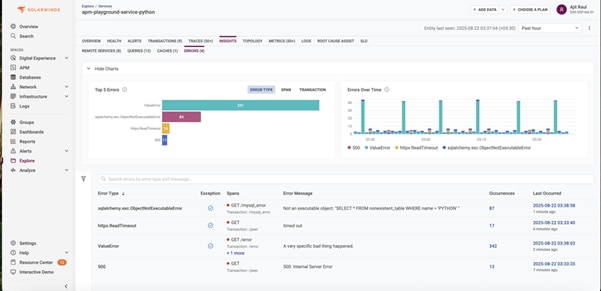
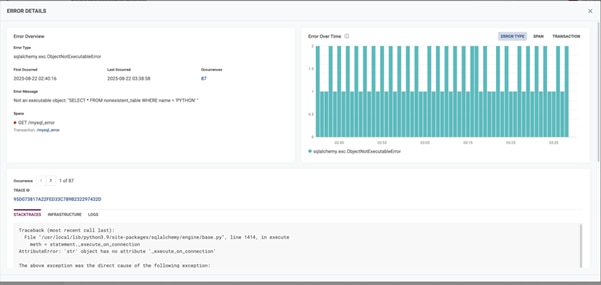
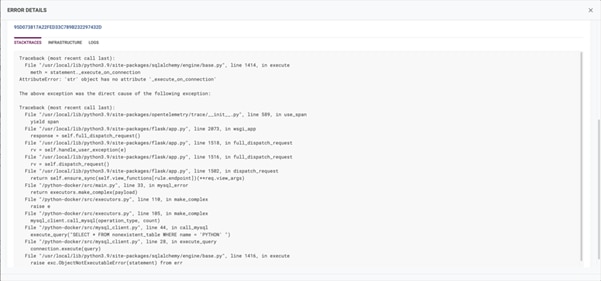
This visibility accelerates RCA by enabling teams to understand the broader error landscape and granular details, reducing mean time to resolution (MTTR).
A Unified Platform for Error Detection, Correlation, and Tracing
Error monitoring through observability is essential for managing modern distributed systems. Business-critical applications require swift and accurate detection and root cause analysis of errors to protect user experience and operational reliability. SolarWinds Observability SaaS APM provides a powerful, unified platform that delivers deep error insights, correlation, and contextual tracing, making it a vital resource for development and operations teams dedicated to application performance and reliability.
Reference Links to SolarWinds Observability SaaS APM Documentation
- SolarWinds Observability SaaS APM Overview
- SolarWinds Observability | Integrate APM with DBO
- SolarWinds Observability | Getting started with APM
- SolarWinds Observability | APM Tracing (Traces Explorer)